
Shockwave Therapy in Noosa, as Part of Your Chiropractic Care
Noosa Life Chiropractic offers shockwave therapy in Noosa at our clinic in The Atrium, Poinciana Avenue, Tewantin. We use radial shockwave, a hands-on treatment for musculoskeletal pain that has settled into a tendon or the tissue around it and hasn’t improved enough with appropriate conservative (non-surgical) care. Think heel pain, a sore Achilles, tennis or golfer’s elbow, or a shoulder that has grumbled for months.
How we use shockwave at Noosa Life
Shockwave is never a one-size-fits-all treatment here. It’s one tool inside a full chiropractic assessment and plan, and we only use it where your assessment shows it’s appropriate. It does not suit everyone and it does not work for everyone, so where it’s appropriate for your problem, we record your pain score and an appropriate objective measure, such as joint range of motion or functional movement, before and after treatment, and we tell you straight whether it’s helping.
Your treatment is with Dr Roberto De Souza (Chiropractor), who is trained and certified in the clinical use of shockwave therapy. No needles, no drugs, a few minutes a session.
What is shockwave therapy?
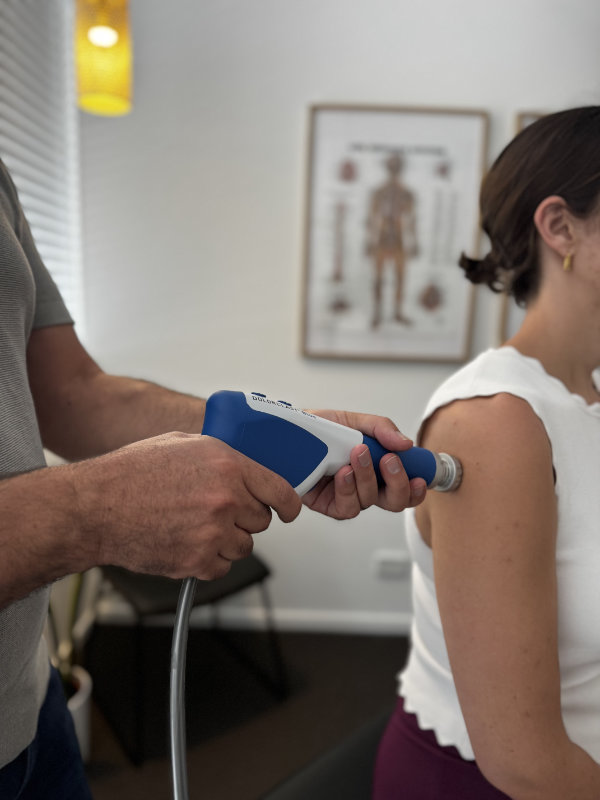
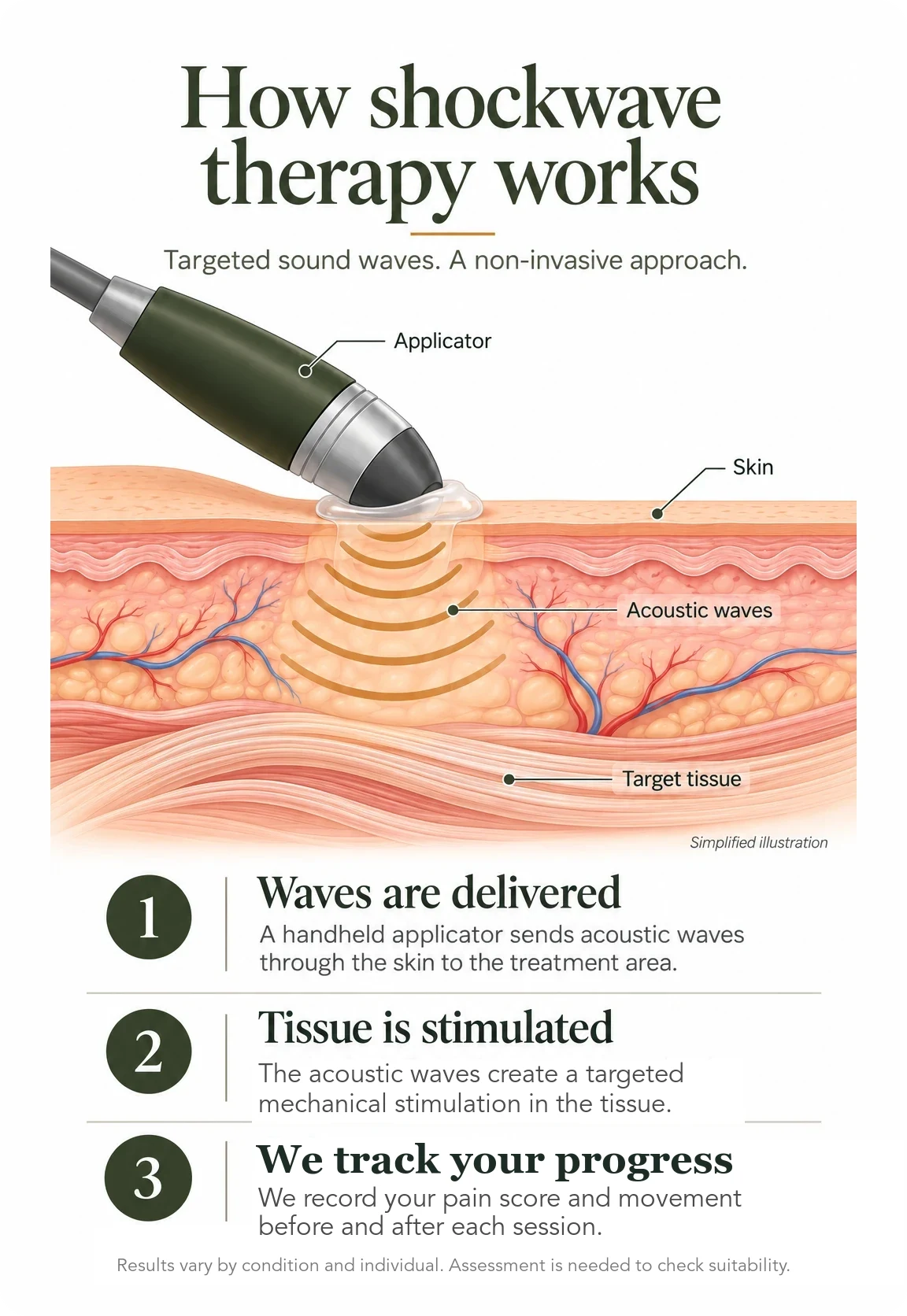
Shockwave therapy, also called extracorporeal shockwave therapy or ESWT, is a non-invasive treatment that sends pulses of pressure through the skin into the muscles, tendons and other soft tissue underneath. Nothing breaks the skin.
There are two main types. Radial shockwave therapy, the type we use, spreads its energy over a wider area and works closer to the surface, for example on tendons around the heel, elbow and shoulder. Focused shockwave therapy concentrates its energy into a smaller point that reaches deeper into the tissue. Shockwave is also offered by physios, podiatrists and osteopaths around Noosa and the Sunshine Coast, and neither type is right for every problem.
Researchers are still studying exactly how shockwave works. That is one reason we measure your response as we go, rather than assume it will help.
What we use shockwave therapy for
Shockwave is used for pain that has settled into a tendon, where it attaches to bone, or the soft tissue around it, and has not improved enough with appropriate conservative care. Tendons are the tough, fibrous bands that attach your muscles to your bones. The problems we most often assess for shockwave are:
- Plantar fasciitis and heel pain. The plantar fascia is the thick band of tissue under your foot that runs from your heel bone to your toes. When it becomes sore, the pain is usually under your heel, and it is often worse in the morning as you take your first steps. It is often seen alongside a heel spur, although plenty of people have a heel spur with no pain at all.
- Achilles pain. Pain in the Achilles, the tendon at the back of your ankle that joins your calf to your heel.
- Tennis elbow and golfer’s elbow. Tennis elbow is soreness on the outside of the elbow, in the tendons that attach your forearm muscles to the bone. It tends to build up over time with repeated use. Golfer’s elbow is soreness on the inside of the elbow.
- Rotator cuff and shoulder pain. The rotator cuff is the group of four muscles and their tendons that hold your shoulder joint stable and help it move. Rotator cuff problems are common in active people and as we get older, and they can make it painful to sleep on that side.
- Hip and glute tendon pain. Pain on the outside of the hip.
- Shin splints. Pain along the shinbone from repeated stress on it, common in runners.
- Jumper’s knee. Pain in the tendon just below the kneecap.
A list like this can’t tell you whether shockwave suits your problem. The evidence behind it is stronger for some of these than others, and we’ll tell you where yours sits after your assessment, before you commit to anything.
What happens at your first visit?
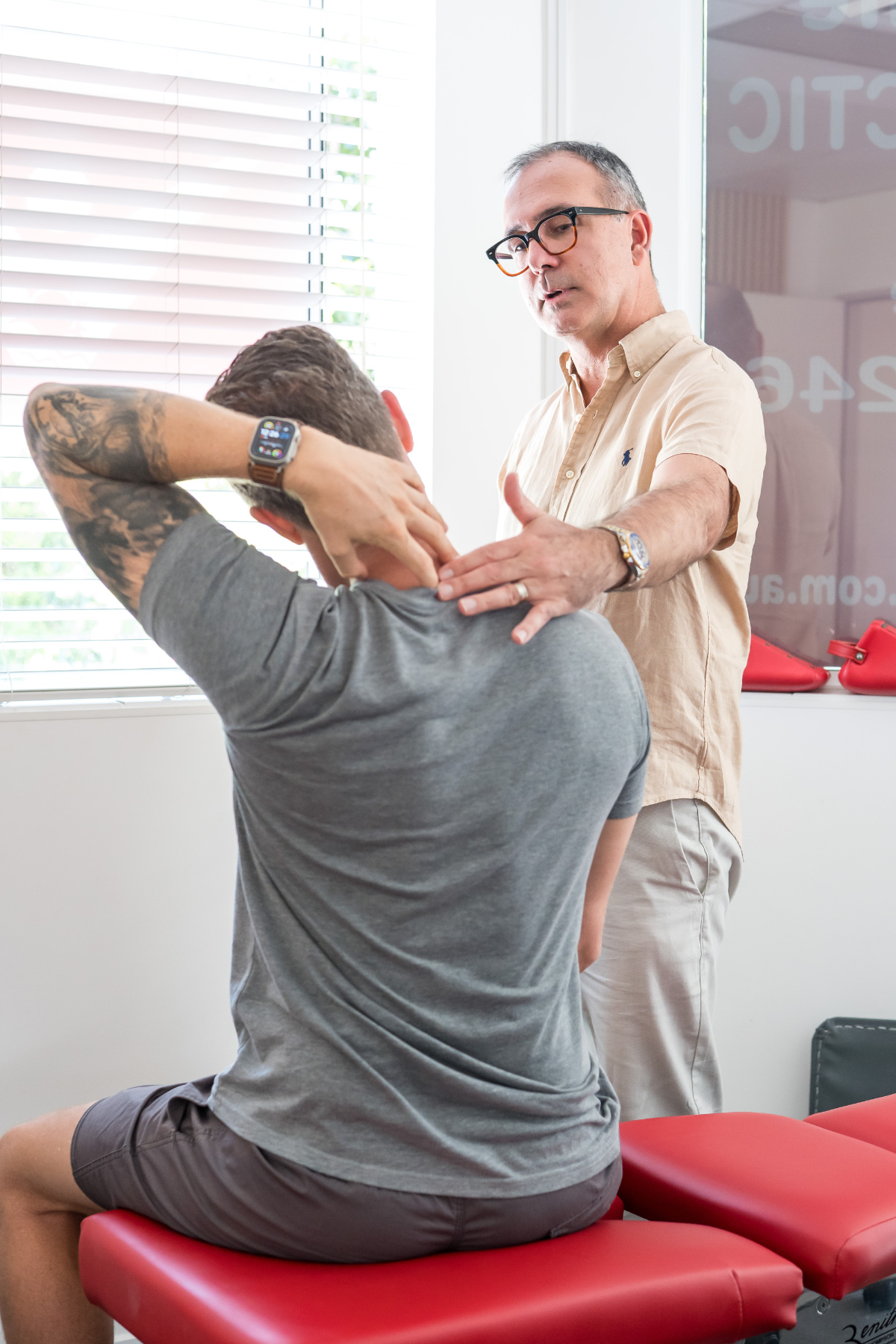
Your first visit is a chiropractic consultation and assessment. Shockwave is only part of that visit if the assessment shows it’s clinically appropriate.
You’ll fill in a patient intake questionnaire (you can do it beforehand through our online forms), then talk through what has brought you in and your health history. We measure how you move, check the painful area, and do any orthopaedic and neurological tests your problem calls for. Then we explain what we found, what we think is going on, and what we can offer, and that includes telling you if shockwave isn’t the right tool.
If shockwave is suitable and you’d like to go ahead, we talk you through what it involves and go over your consent before we start. There’s more on what to expect on our new patients page.
What a shockwave session is like
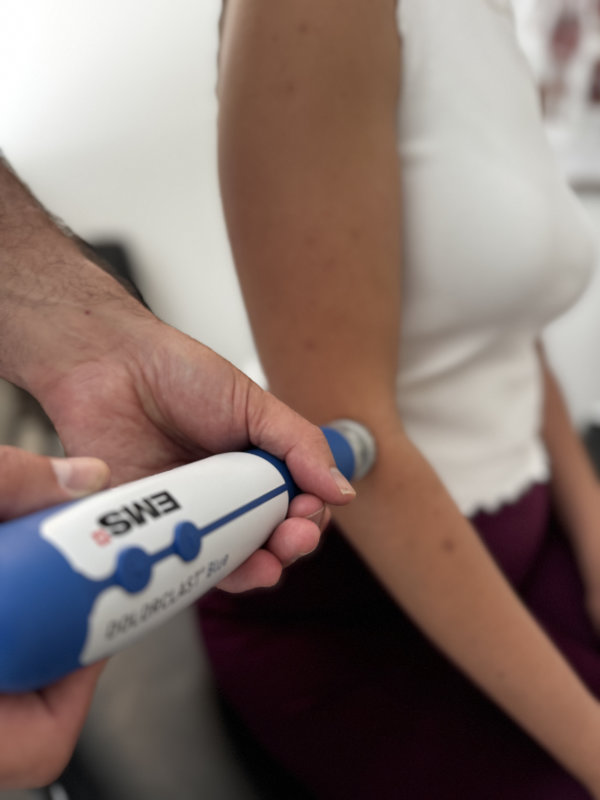
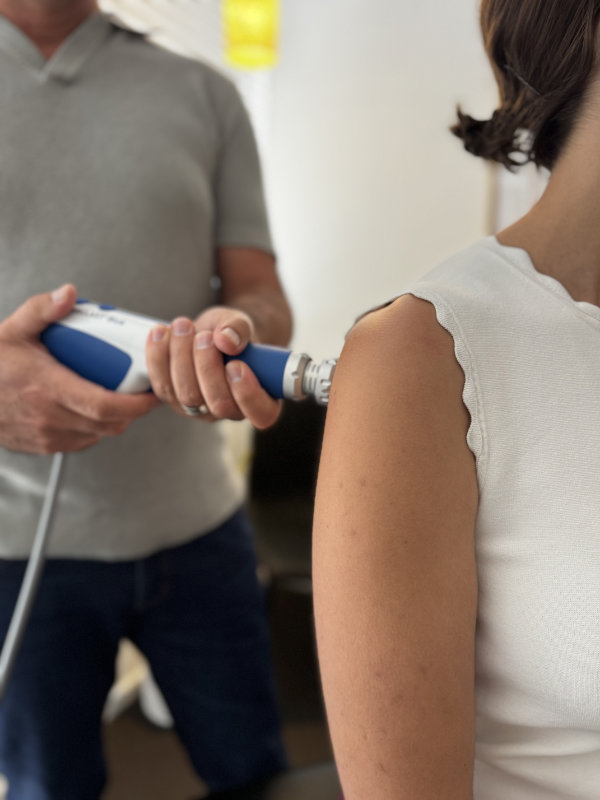
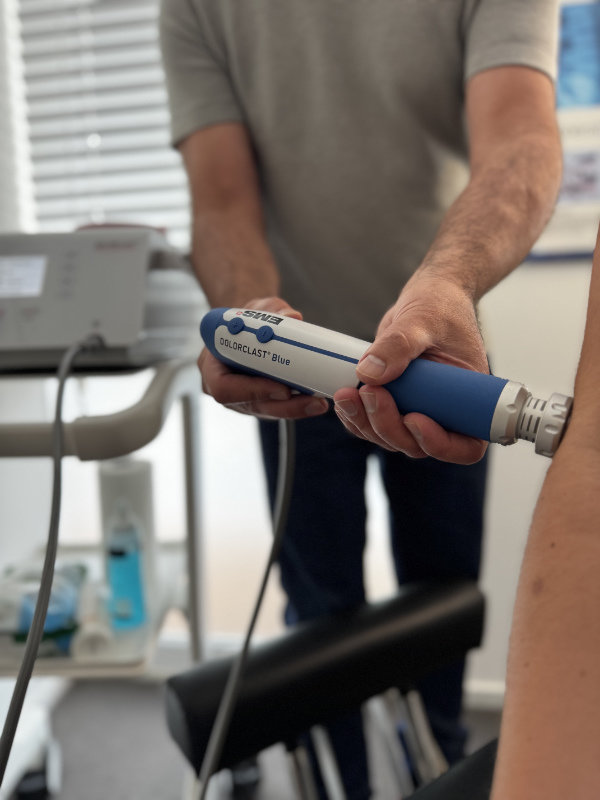
A little gel goes on your skin over the sore spot, and a handheld applicator is pressed against it. The applicator delivers a series of quick pulses into the tissue underneath. The shockwave part of a session takes a few minutes.
People describe it as a firm, pulsing pressure. Some find it uncomfortable during the session. If a spot feels especially sensitive, tell us and we’ll adjust the settings or stop.
Afterwards, you may have some temporary soreness, tenderness, redness or occasionally mild bruising around the treated area. This is generally short-lived. Everyone responds differently, and we’ll give you specific guidance on the day about activity, exercise and sport.
How a course of treatment runs
Where we use shockwave, the course follows the same shape:
- Assess. We work out what’s going on and whether shockwave is the right tool for it.
- Treat. The shockwave session itself, alongside the rest of your chiropractic care where that’s what you need.
- Rehabilitate. Simple exercises between sessions to back up the treatment.
- Follow up. We check how you’re responding and adjust the plan from there.
Where we use shockwave, we usually plan a course of around three to six sessions. That is a planning figure, not a prediction about your result. It varies with the person, how long the problem has been there and how you respond, and some people improve while some do not. We reassess your progress throughout, not just at the end, and decide together whether to continue, change the approach or stop.
No packages, no lock-in. We don’t sell a fixed number of sessions upfront, because how many you need depends on your presentation and how you respond.
We measure how you’re responding
Where it’s appropriate for your problem, we record two things before and after treatment: your pain, scored from 0 to 10, and an appropriate objective measure such as joint range of motion or functional movement.
That means you’re not taking our word for it, and you’re not taking a machine’s word for it either. You can see, in your own numbers, how you are responding to this particular treatment on your particular problem. If it isn’t moving after a few sessions, we’ll tell you honestly and talk about what happens next.
Who shockwave therapy is not for
Shockwave isn’t right for everyone, and we’d rather tell you now than after you’ve paid for a session.
This is not a complete list, and it is not a substitute for an assessment. We won’t use shockwave if you are:
- Pregnant
- Under 18, except where there is an appropriate clinical indication and treatment has been discussed with the young person and their parent or guardian. This may include selected presentations such as Osgood-Schlatter disease.
- On blood thinners, or you have a blood-clotting disorder
- Currently dealing with a local infection or a tumour at the treatment site
- Within six weeks of a cortisone injection in that area
- Dealing with a tendon that may already be torn or ruptured, rather than just sore
We also avoid treating directly over the lungs, gut or other air-filled areas of the body.
Tell us your health history honestly at your first visit, and we’ll tell you straight whether shockwave is the right tool for you, or whether something else makes more sense.
Where shockwave fits with the rest of your care
Shockwave is one clinical tool, not the whole plan. Depending on what your assessment finds, it may sit alongside chiropractic care, exercises you do at home, remedial massage with our massage team, or foot scanning if the way you stand and walk is part of the picture.
Physios, osteopaths and podiatrists around Noosa and the Sunshine Coast also offer shockwave, and they are legitimate places to have it done. Here, shockwave sits inside a chiropractic assessment and plan. Before we treat the sore spot we look at how you move and how you load that side, because a sore tendon can be one that is being asked to do more than its share. We can’t tell you that this changes your result. What we can tell you is what we look at, why we look at it, and what we found when we looked at you.
Who treats you
It’s a fair question to ask who is treating you, and what training they have.
Dr Roberto De Souza (Chiropractor) is registered with the Chiropractic Board of Australia and graduated from Palmer College of Chiropractic in the United States. He has completed specific training and certification in the clinical application of shockwave therapy, through a program run by the manufacturer of the equipment we use. You can read more about Roberto and the team on our meet the team page.
Does shockwave therapy work?
The research on shockwave for tendon pain is mixed. It is better for some problems than others, and for a few of the things people ask us about there is not much evidence either way. If you want to see what the research actually says for your specific problem, ask us and we’ll show you what we’re relying on, including where it falls short. If we don’t think the evidence supports using it for you, we’ll tell you and talk about what we would try instead.
This isn’t a machine we reach for because we bought one. It’s one tool among several, and we’ll only recommend it where your assessment indicates it is clinically appropriate.
Cost, health funds and Medicare
Fees. We don’t sell packages or lock you into a set number of sessions.
- Initial chiropractic consultation and assessment, including shockwave where it’s clinically appropriate: $110. Private health rebate: the chiropractic consultation may be eligible for a rebate, depending on your fund and your level of extras cover.
- Chiropractic adjustment with shockwave: $95. Private health rebate: the chiropractic consultation may be eligible for a rebate, depending on your fund and your level of extras cover.
- Standalone shockwave session, after your initial assessment: $65. No private health rebate.
Private health funds. When shockwave is part of a chiropractic consultation, the visit is billed as a chiropractic consultation, so it may be eligible for your normal chiropractic rebate, depending on your fund and your level of extras cover. A standalone shockwave session doesn’t attract a private health rebate. We can’t tell you what your policy will pay, so check with your fund before you book.
Medicare. If you have a chronic condition and complex care needs, your GP may prepare a GP chronic condition management plan and refer you for allied health services under it, which can attract a Medicare rebate for up to five allied health services in a calendar year, shared across all your allied health providers. Your GP decides whether you’re eligible. If you have that referral, and chiropractic care is part of your GP’s plan, a chiropractic consultation that includes shockwave may be claimable under Medicare as a chiropractic consultation. Medicare has conditions, including that the consultation runs for at least 20 minutes, so ask us when you book whether your appointment will meet them. Shockwave itself doesn’t attract a separate Medicare rebate. You can’t claim a Medicare benefit and a private health fund rebate for the same service.
Booking shockwave therapy in Noosa
If you’ve tried appropriate conservative care and your problem still hasn’t improved enough, an assessment can help determine what may be contributing to it and whether shockwave therapy is appropriate for you.
Noosa Life Chiropractic
The Atrium, 24/91 Poinciana Ave, Tewantin QLD 4565
Phone 0409 570 246
Contact us
Opening hours (closed public holidays)
- Monday: 8:00am to 12:00pm, 2:00pm to 6:00pm
- Tuesday: 8:00am to 12:00pm, 1:00pm to 5:00pm
- Wednesday: 8:00am to 12:00pm, 2:00pm to 6:00pm
- Thursday: 8:00am to 12:00pm, 1:00pm to 5:00pm
- Friday: 8:00am to 12:00pm, 2:00pm to 6:00pm
- Saturday: 7:00am to 12:00pm
- Sunday: Closed
Noosa Life Chiropractic is rated 4.9 on Google across all our services.
What our clients say
Rated 4.9 out of 5 stars based on 95 customer reviews.